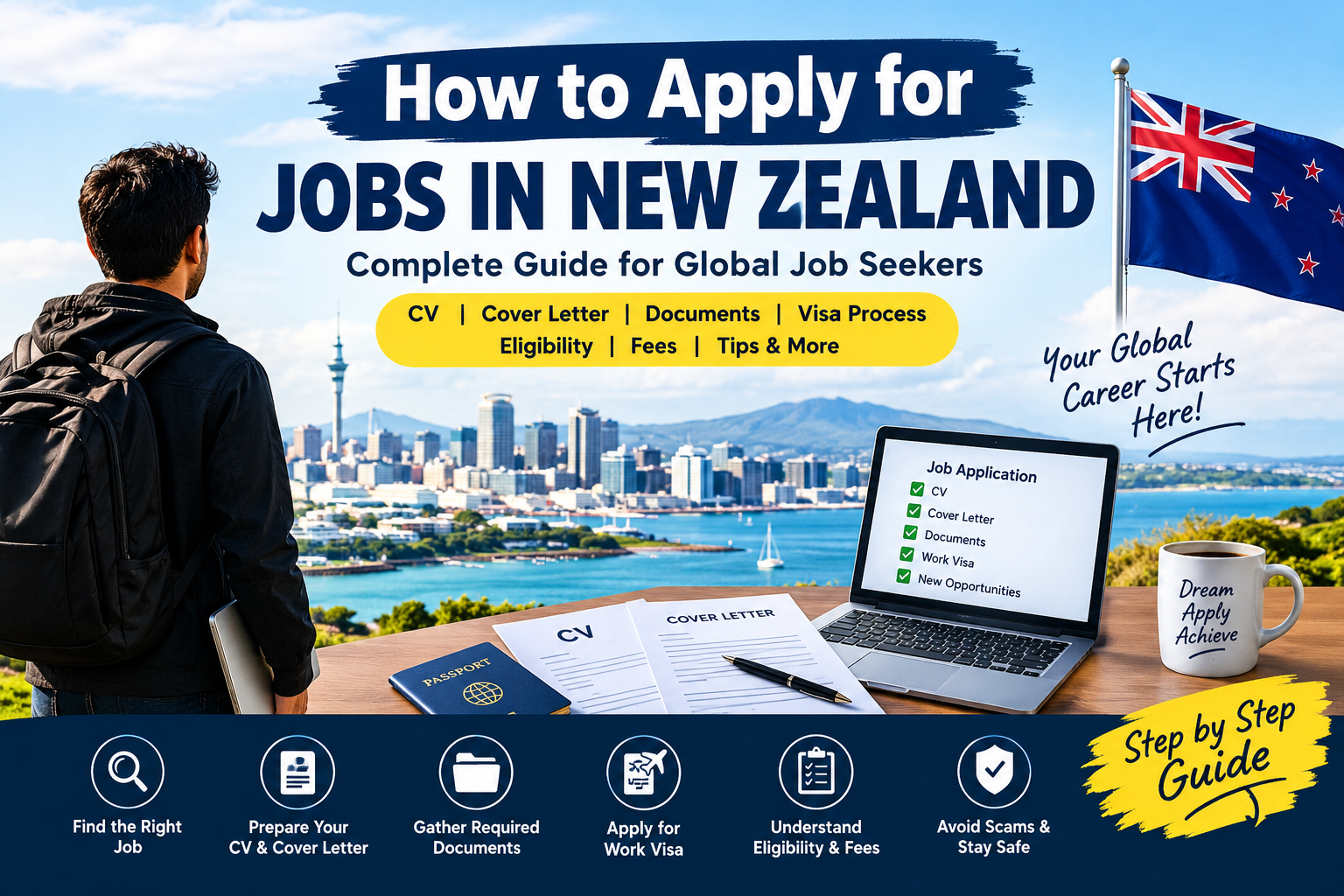
New Zealand is one of the countries that attracts international workers in industries such as agriculture, construction, healthcare, engineering, hospitality, logistics, food processing, and other sectors.
However, applying for a job in New Zealand from Pakistan is not simply a matter of sending a CV and waiting for a visa.
A genuine application usually involves several steps:
Find a suitable job → Check your eligibility → Prepare your CV → Write a cover letter → Apply to the employer → Attend an interview → Receive a genuine job offer → Check the employer and job → Apply for the appropriate work visa.
This guide explains the process in detail so that Pakistani job seekers can understand how to apply for jobs in New Zealand, what documents they may need, what eligibility requirements can apply, how the Accredited Employer Work Visa works, what the current visa fees are, and how to avoid fake job offers.
Important: Immigration and employment rules can change. The information below reflects the official New Zealand information available in October 2026. Applicants should always check the latest requirements with Immigration New Zealand before submitting an application.
1. Can You Apply for a New Zealand Job From Pakistan?
Yes.
You do not necessarily have to travel to New Zealand first to look for employment.
Immigration New Zealand states that people can look for jobs from overseas through employment websites, recruitment companies and by contacting employers directly. New Zealand also has employers who recruit people from overseas.
However, being able to apply for a job does not mean that you automatically qualify for a New Zealand work visa.
The job, employer and applicant must meet the requirements of the relevant immigration pathway.
2. The First Step: Choose the Right Job
Before searching for jobs, understand your own profile.
Ask yourself:
- What education do I have?
- What occupation do I work in?
- How many years of genuine experience do I have?
- What skills do I have?
- Do I have professional training?
- Do I have certificates?
- Do I have a driving licence?
- Does my occupation require professional registration?
- Does my experience match the job I want?
For example, someone with genuine agriculture experience should look at suitable agriculture, farming, horticulture, harvesting or related positions rather than applying randomly for jobs that have nothing to do with their background.
Similarly:
Warehouse experience → Warehouse / Logistics jobs
Electrician experience → Electrical jobs
Construction experience → Construction / Trade jobs
Healthcare qualification and registration → Relevant healthcare positions
Your application becomes stronger when your CV, experience, qualifications and target job all match.
3. Where Can You Find New Zealand Jobs?
There are several ways to search for vacancies.
Employer Websites
Search for New Zealand companies operating in your industry and visit their official Careers or Jobs section.
Employment Websites
New Zealand has a large number of job and recruitment websites.
Immigration New Zealand itself advises overseas job seekers to use employment websites, recruitment companies and direct employer contact.
Recruitment Companies
Recruitment companies can also connect candidates with employers.
However, applicants should verify the recruitment company and understand exactly what service they are paying for, if any.
Industry-Specific Websites
Some industries have dedicated recruitment platforms or professional organisations.
For example, healthcare professionals may need to use sector-specific recruitment channels and also meet New Zealand professional registration requirements.
4. How to Search for Jobs Correctly
Do not simply search:
“New Zealand jobs for Pakistanis.”
Use your actual occupation.
For example:
- Farm Worker jobs New Zealand
- Agriculture jobs New Zealand
- Fruit Picker jobs New Zealand
- Packhouse Worker jobs New Zealand
- Warehouse Worker jobs New Zealand
- Food Processing jobs New Zealand
- Construction Worker jobs New Zealand
- Electrician jobs New Zealand
- Plumber jobs New Zealand
- Driver jobs New Zealand
- Care Worker jobs New Zealand
- Hospitality jobs New Zealand
If you are searching for jobs that may be suitable for overseas workers, you may also see terms such as:
Visa sponsorship
International applicants
Overseas applicants
Accredited employer
But never assume that a job is visa-sponsored simply because someone has written “visa sponsorship” in a social-media post.
Always check the original vacancy and employer.
5. Check Whether the Employer Is Accredited
This is especially important if you are considering an Accredited Employer Work Visa (AEWV).
Immigration New Zealand provides an official Accredited Employer List where applicants can check whether an employer is currently accredited.
The database can be searched using the employer’s company name, trading name or New Zealand Business Number (NZBN), and the list is updated daily.
This is one of the best checks you can make before relying on an overseas job offer.
6. What Is the Accredited Employer Work Visa?
The Accredited Employer Work Visa (AEWV) is one of New Zealand’s major temporary work visa pathways.
It is designed for people who have a qualifying job offer from an accredited employer.
According to the current Immigration New Zealand information, an AEWV applicant needs:
- A full-time job offer from an accredited employer
- The required skills, experience and/or qualifications
- To meet the other requirements of the visa
- English ability where the rules require it
- Any required health and character requirements.
The visa allows the worker to work for the accredited employer that offered the job and requires at least 30 hours of work per week under the relevant job offer.
7. How Does the AEWV Process Work?
The process involves more than the worker simply submitting a visa application.
A simplified process is:
Step 1 — Employer Accreditation
The employer must be accredited to hire migrants under the relevant scheme.
Step 2 — Job Check
The employer normally needs an approved job check for the position.
Step 3 — Genuine Job Offer
The employer offers the suitable migrant worker the job.
Step 4 — Employer Sends Visa Application Link
For an AEWV, the employer provides the worker with a job offer, job description, employment agreement and a unique link to the online visa application.
Step 5 — Worker Applies for the Visa
The applicant submits the required documents and pays the applicable visa fee.
Step 6 — Immigration New Zealand Assesses the Application
INZ may request additional information, medical evidence or other documents.
This means a person should be suspicious if someone says:
“Just pay us and we will give you an AEWV.”
The genuine process involves an employer, a qualifying job and Immigration New Zealand’s assessment.
8. What Is the Current AEWV Visa Fee?
According to the current Immigration New Zealand AEWV page, the Accredited Employer Work Visa costs from NZD $1,540.
However, applicants should understand the wording “from”.
Immigration New Zealand explains that visa costs can depend on factors including the applicant’s citizenship and where they are applying from. Its official fee finder should therefore be checked before payment.
Important
Do not write on your website:
“New Zealand Embassy fee is exactly X Pakistani rupees.”
That can quickly become outdated because exchange rates change and visa charges can change.
A safer and more accurate statement is:
Current AEWV application fee: from NZD $1,540. Applicants should confirm the final applicable fee through Immigration New Zealand’s official fee finder before submitting the application.
This keeps your website much more credible.
9. What About Employer Accreditation and Job Check Fees?
These are employer-side costs, not the worker’s normal visa application fee.
Immigration New Zealand currently lists:
- Standard employer accreditation: NZD $775
- High-volume accreditation: NZD $1,280
- Triangular accreditation: NZD $4,060
- Job Check: NZD $735
These fees are paid by the employer through the relevant employer process.
Very Important for Job Seekers
Immigration New Zealand states that New Zealand employers cannot charge workers for a job or make workers pay the employer’s recruitment costs. This includes recruitment costs charged indirectly through a third party.
Therefore, applicants should be extremely careful if someone says:
“You must pay the employer’s accreditation fee.”
or:
“You need to pay the Job Check fee to get your job.”
These claims should be independently verified.
10. What Should Your New Zealand CV Look Like?
Your CV is one of the most important parts of your job application.
New Zealand career guidance recommends a CV that is:
- Easy to read
- Relevant to the job
- Short and focused
- Professionally written
- Based on genuine skills and experience
New Zealand career guidance also recommends tailoring the CV for each application rather than using exactly the same CV for every job.
A professional CV can include:
Personal Details
- Full name
- Phone number
- Professional email
- Current location
- LinkedIn profile, if relevant
Professional Summary
A short paragraph explaining your occupation, experience and major strengths.
Work Experience
For each job:
Job Title
Company Name
Location
Employment Dates
Then list your actual responsibilities and achievements.
Education
Include relevant:
- Degrees
- Diplomas
- Certificates
- Training
Skills
Include skills relevant to the position.
Certifications
Add relevant professional or technical certificates.
References
Include references where requested or appropriate.
11. Should You Put Your Photo on a New Zealand CV?
New Zealand career guidance recommends not putting photos or images on a standard CV. It also advises against including unnecessary personal information such as age, marital status, religion or bank details.
Therefore, candidates preparing a New Zealand CV should generally focus on:
Skills + Experience + Qualifications + Achievements
rather than unnecessary personal information.
12. Keep Your CV Short and Relevant
New Zealand career guidance recommends keeping a CV concise and easy to scan, with two pages being a useful general target.
This does not mean someone with a long professional career must force everything into exactly two pages.
The important principle is:
Include relevant information and remove unnecessary information.
A warehouse employer does not need a five-page life story.
A farm employer does not need unrelated office experience taking up most of the CV.
13. Your CV Must Match Your Actual Experience
This is extremely important for overseas job applications.
Never add:
- Fake companies
- Fake certificates
- Fake experience
- Fake job titles
- Fake responsibilities
- Fake qualifications
Immigration New Zealand requires evidence supporting claimed job experience, skills and qualifications in relevant work visa applications.
For some AEWV applicants, the employer also has to check that the migrant is suitably qualified and skilled for the job. Evidence may include documents supporting the CV or practical/interview evidence.
14. What Is a Cover Letter?
A cover letter is a short professional document submitted with your CV when required or useful.
Its purpose is to explain:
Who you are + what experience you have + why you are suitable for this specific job.
New Zealand career guidance describes the cover letter as a short “sales pitch” explaining why you are the right person for the specific position. It recommends keeping it brief, generally no longer than one page.
15. What Should a Cover Letter Include?
A good cover letter can follow this structure:
Paragraph 1
State the job you are applying for.
Paragraph 2
Explain your relevant experience.
Paragraph 3
Highlight skills that match the job description.
Paragraph 4
Explain your interest in the employer and position.
Closing
State your availability and invite the employer to contact you.
Do not simply copy the same cover letter for every employer.
Change it according to the vacancy.
16. What Documents Do You Need?
There is no single document list that applies to every New Zealand job.
Requirements depend on the job, employer and visa.
However, candidates should prepare a document folder containing relevant documents such as:
Employment Documents
- Experience certificates
- Employment letters
- Reference letters
- Employment contracts, where available
- Payslips or other employment evidence where relevant
Education Documents
- School certificates
- Diplomas
- Degrees
- Transcripts
- Training certificates
Identity Documents
- Valid passport
- Identity document where relevant
Professional Documents
Depending on the occupation:
- Trade certificates
- Professional licences
- Registration documents
- Driving licence
- Safety certificates
Immigration Documents
Depending on the visa:
- Job offer
- Employment agreement
- Job description
- Police certificate
- Medical evidence
- Chest X-ray
- English evidence where required
- Certified translations
AEWV applicants may need to provide evidence of job experience, skills, qualifications and occupational registration where applicable.
17. Employment Experience Must Be Genuine and Verifiable
A CV by itself may not always be enough.
Immigration New Zealand specifically requires evidence for relevant AEWV work experience and qualifications.
Examples of useful evidence can include:
- Employment certificates
- Letters from employers
- Payslips
- Tax records
- Qualification documents
- Registration evidence
The exact evidence required depends on the application.
The important point is:
Do not create experience only on paper.
Your employment history should be genuine and supported by evidence where required.
18. Do You Need IELTS or an English Test?
This is an area where applicants often receive incorrect advice.
There is not one universal IELTS rule for every New Zealand job.
The requirement depends on the visa, occupation and circumstances.
For the AEWV, English requirements apply to certain skill levels. Immigration New Zealand announced that from 1 June 2026, the minimum English requirement was extended to AEWV occupations assessed at ANZSCO/NOL skill level 3; skill levels 4 and 5 already had an English requirement.
Therefore, do not tell every applicant:
“IELTS is compulsory for all New Zealand jobs.”
That statement is not accurate.
Check the specific occupation and visa requirements.
19. Does Your Qualification Need to Be Assessed?
Sometimes.
If you are using an overseas qualification to support a New Zealand visa application, you may need an International Qualification Assessment (IQA) or another form of qualification recognition, depending on the qualification and visa pathway.
Immigration New Zealand advises applicants to check whether an international qualification assessment is required.
This is particularly important for professional and skilled occupations.
20. Do Some Jobs Require Professional Registration?
Yes.
Some professions require registration before you can legally work in New Zealand.
This can apply to certain:
- Healthcare professions
- Engineering roles
- Teaching roles
- Trades
- Other regulated occupations
Immigration New Zealand advises applicants to check whether their occupation requires registration with a relevant New Zealand professional body.
Having experience alone may not be enough for a regulated occupation.
21. Police Certificate Requirements
Character requirements depend on the visa and the applicant.
For AEWV applicants, Immigration New Zealand states that applicants aged 17 or older generally need police certificates when their total time in New Zealand will be 24 months or longer, subject to the relevant rules and exceptions.
Where required, police certificates must meet INZ’s validity requirements and be provided with the application.
This is another reason why applicants should not use a random internet checklist for every visa.
22. Medical Examination and Chest X-Ray
Depending on the visa and personal circumstances, Immigration New Zealand may require:
- Medical examination
- Chest X-ray
- Medical certificates
If medical or X-ray evidence is required, INZ has specific requirements regarding the validity of the evidence and approved processes.
Applicants should follow the current INZ instructions rather than arranging medical documents based on outdated social-media information.
23. What Happens After You Apply for the Job?
If an employer is interested, they may contact you for:
- Telephone interview
- Video interview
- Skills assessment
- Practical test
- Reference check
- Document verification
Prepare for the interview by studying:
- Your own CV
- The job description
- The employer
- Your previous responsibilities
- Your skills
If an employer asks:
“Tell us about your previous warehouse experience.”
Do not give a one-line answer if you have substantial experience.
Explain the real tasks you performed.
24. What Happens If You Get Selected?
If the employer selects you, carefully check the employment documents.
For an AEWV application, the employer needs to provide the relevant job offer, job description and employment agreement, along with the unique application link for the worker.
Check:
- Job title
- Employer name
- Location
- Salary/pay rate
- Hours
- Duties
- Contract duration
- Leave
- Overtime arrangements
- Any deductions
- Conditions of employment
Never sign a document that you do not understand.
25. Seasonal Jobs in New Zealand
New Zealand has specific seasonal work visa options.
As of the current 2026 system, two important seasonal AEWV options include:
Global Workforce Seasonal Visa — GWSV
The GWSV is for jobs on the GWSV job list.
The current INZ page states:
- Visa duration: up to 9 months each year
- Visa validity: 3 years
- Work: up to 3 seasons
- At least 3 months outside New Zealand between seasons
- At least 30 hours of work per week
- Cost: from NZD $1,540
- Applicant must have worked at least 3 seasons in the same or similar job during the previous 6 years.
This last requirement is particularly important.
A person should not advertise a GWSV as an option for every applicant with zero seasonal experience.
Peak Seasonal Visa — PSV
The PSV is another seasonal option.
The current INZ information states:
- Work for up to 7 months
- At least 30 hours per week
- Cost from NZD $1,540
- The job must be on the PSV job list
- The employer must be accredited.
Eligibility requirements are different from the GWSV, so applicants should check the exact visa before applying.
26. Important Change to Seasonal Work Visas
Applicants should be careful with older information online.
Immigration New Zealand states that from 8 December 2025, seasonal workers are handled through the newer seasonal AEWV options such as the Global Workforce Seasonal Visa (GWSV) and Peak Seasonal Visa (PSV) for eligible jobs, rather than the previous interim seasonal Specific Purpose Work Visa arrangement.
This means old YouTube videos and old Facebook posts can contain information that is no longer applicable.
27. How Much Money Should You Pay for a New Zealand Job?
There is no legitimate universal price for a New Zealand job.
A job offer should not be treated as something that an applicant simply purchases.
Immigration New Zealand states that employers cannot charge workers for a job or make workers pay the employer’s recruitment costs.
You may legitimately have costs associated with:
- Visa application
- Medical examination
- Chest X-ray, if required
- Police certificate
- Document translation
- Qualification assessment, if required
- Professional registration, if required
- Airfare
- Personal relocation expenses
- Professional advisory services, if you choose to use them
But these are different from paying an employer for a job.
28. What Is the Current Visa Processing Time?
Processing times can change.
The current AEWV page states that 80% of applications are processed within 5.5 weeks, but this is not a guarantee that every application will be completed within that time.
Applications can take longer if:
- Documents are missing
- INZ requests additional information
- Medical evidence is required
- Character checks are required
- Information needs verification
Therefore, never advertise:
“New Zealand visa guaranteed in 30 days.”
A processing-time estimate is not a guarantee.
29. Beware of Fake New Zealand Job Offers
This is extremely important for Pakistani applicants.
A fake job offer may contain:
- A fake employment contract
- A fake company
- Fake immigration documents
- Fake employer emails
- Fake visa approval letters
- Pressure to pay quickly
- A promise of guaranteed visa approval
Before trusting a job offer, check the employer independently.
Use the official Immigration New Zealand accredited employer search where relevant.
30. Do Not Trust “100% Visa Guarantee”
No consultant, agent or employer can honestly guarantee an immigration decision simply because you paid them.
Immigration New Zealand makes the immigration decision according to the applicable rules and the information provided in the application.
INZ also states that using an adviser does not cause an application to be prioritised or guarantee a faster decision.
Be careful with statements such as:
“100% visa guarantee.”
“Guaranteed job.”
“No eligibility required.”
“No documents required.”
“Pay today or you will lose the job.”
These are major warning signs.
31. A Professional New Zealand Job Application Strategy
If you are applying from Pakistan, use this sequence:
Step 1
Identify your actual occupation.
Step 2
Research suitable New Zealand jobs.
Step 3
Read the job requirements carefully.
Step 4
Check whether international applicants are accepted.
Step 5
Check the employer.
Step 6
Check whether the employer is accredited if the relevant visa requires accreditation.
Step 7
Prepare a New Zealand-style CV.
Step 8
Prepare a targeted cover letter.
Step 9
Prepare genuine experience and qualification documents.
Step 10
Submit the application through the employer’s specified channel.
Step 11
Attend the interview.
Step 12
Review the employment agreement carefully if selected.
Step 13
Receive the appropriate employer/job documentation.
Step 14
Apply for the relevant work visa through Immigration New Zealand.
Step 15
Wait for the immigration decision before making major non-refundable travel arrangements.
32. New Zealand Job Application Checklist
Before applying, make sure you have:
CV
☐ Updated CV
☐ Relevant work experience
☐ Correct employment dates
☐ Correct job titles
☐ Relevant skills
☐ Education
☐ Certificates
Cover Letter
☐ Correct employer name
☐ Correct job title
☐ Relevant experience
☐ Professional language
☐ One-page focused format
Documents
☐ Passport
☐ Education documents
☐ Experience certificates
☐ Training certificates
☐ Professional registration, if required
☐ Driving licence, if relevant
☐ Police certificate, if required
☐ Medical/X-ray, if required
☐ English evidence, if required
☐ Certified translations, if required
Employer
☐ Employer verified
☐ Job vacancy verified
☐ Accredited status checked where relevant
☐ Employment conditions understood
Visa
☐ Correct visa category identified
☐ Eligibility checked
☐ Current INZ fee checked
☐ Official INZ requirements checked
33. Final Thoughts: How to Apply for Jobs in New Zealand Successfully
Applying for a New Zealand job from Pakistan should be treated as a professional employment process followed by an immigration process.
The correct approach is not:
“Find someone who can sell a visa.”
The correct approach is:
“Find a genuine job that matches my profile, apply professionally, receive a legitimate job offer, and then meet the requirements of the correct New Zealand work visa.”
Your CV should show your genuine skills and experience.
Your cover letter should be written for the actual job.
Your documents should support the information in your CV.
Your employer should be genuine and, where required, accredited.
Your employment agreement should clearly explain your job and conditions.
And your visa application should be based on the current official Immigration New Zealand requirements.
Most importantly, always verify current fees and visa requirements before submitting an application, because immigration fees, visa categories and eligibility rules can change.
Need Professional Help With Your New Zealand Job Application?
If you need assistance preparing your CV, cover letter, job application documents and New Zealand employment application, Adam Visa Consultancy can help you prepare your documents professionally.
Adam Visa Consultancy Private Ltd
📍 12#, Jinnah Center Plaza, Jinnah Garden Phase 1, Islamabad
🌐 Adamvisa.pk
📧 info@adamvisa.pk
📱 WhatsApp: 03296272273 — Aoun
📞 03026319144 — Waseem