Meta title: RSE Visa New Zealand 2026: Eligibility, Fees, Pay & FAQs
Meta description: Complete 2026 guide to New Zealand’s Recognised Seasonal Employer (RSE) scheme. See eligible Pacific nations, the 7-month stay, fee, pay rules, medical insurance, employer duties and FAQs.
URL slug: recognised-seasonal-employer-rse-visa-new-zealand-2026
What Is the RSE Scheme?
The Recognised Seasonal Employer (RSE) scheme allows a set number of overseas workers to work for Recognised Seasonal Employers in New Zealand’s horticulture and viticulture industries. INZ says the jobs are planting, maintaining, harvesting and packing crops. One aim of the scheme is to encourage economic development in the Pacific, so citizens of eligible Pacific countries get preferential access.
Workers come on the RSE Limited Visa. A limited visa restricts your stay to the express purpose it was granted for, in this case working for an RSE.
RSE Visa at a Glance
| Detail | Information (from INZ) |
|---|---|
| Length of stay | Normally up to 7 months in any 11-month period |
| Cost | From NZD $325 |
| Processing time | 80% within 2 days |
| Age | 18 or older |
| Visas available | 20,750 each year |
| Who can apply | Citizens of eligible Pacific nations (normally) |
| Insurance | Full medical insurance for the whole stay |
| Family | Cannot be included |
Eligible Countries
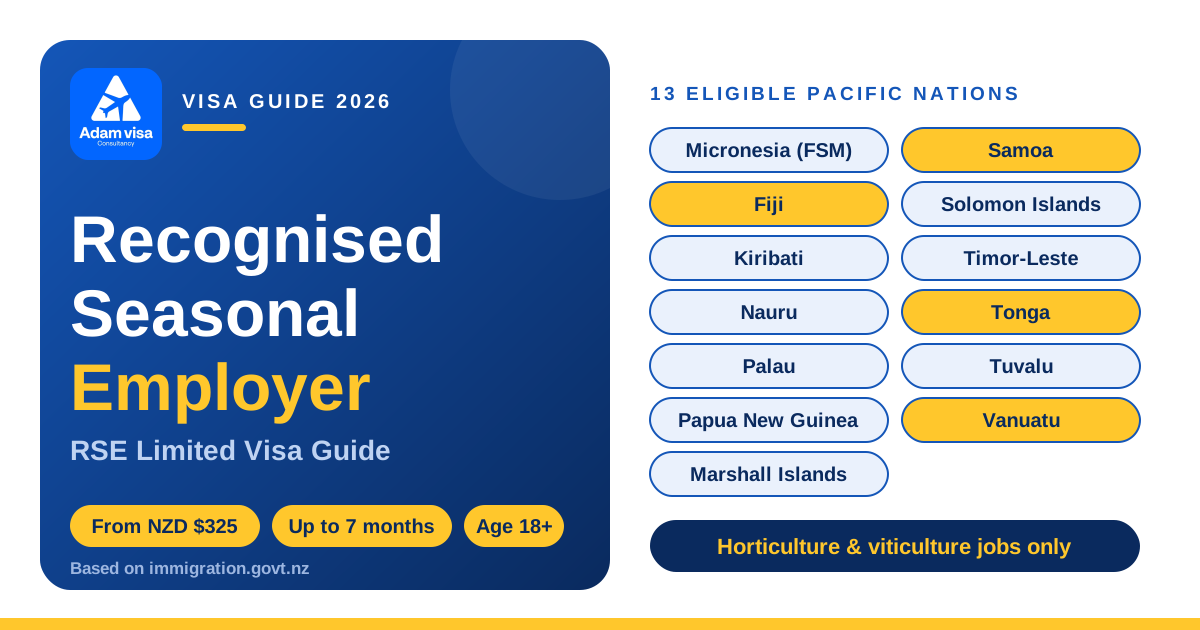
INZ says the visa is normally given only to citizens of these 13 nations:
Federated States of Micronesia, Fiji, Kiribati, Nauru, Palau, Papua New Guinea, Republic of Marshall Islands, Samoa, Solomon Islands, Timor-Leste, Tonga, Tuvalu and Vanuatu.
In exceptional circumstances, employers can recruit from other nations, but they must get INZ’s agreement first.
Who Can Apply?
You must:
- Be aged 18 or older.
- Be a citizen of an eligible Pacific nation (unless INZ agrees otherwise).
- Have a job offer from an employer with RSE status that holds an Agreement to Recruit (ATR).
- Have full medical insurance for your stay.
- Be in good health and of good character.
- Be “bona fide”, meaning you genuinely intend a temporary stay to work and then leave.
How Long Can You Stay?
- Most countries: a maximum of 7 months in any 11-month period. Your maximum stay depends on your arrival date.
- Citizens and residents of Tuvalu and Kiribati: up to 9 months in an 11-month period.
- You must leave New Zealand before your visa expires. Staying on risks deportation.
- In exceptional circumstances, and if you have not used your maximum time, you may apply for a further RSE Limited Visa to keep working for an RSE.
- INZ’s guide says there is no limit on how many times you can return under the RSE scheme, as long as INZ’s requirements are met and you and your employer followed immigration and employment rules.
Job Offer, Hours and Pay
- The offer must be from a Recognised Seasonal Employer, with a signed employment agreement (one for each employer if you will work for more than one).
- You must be paid a minimum of 30 hours a week, averaged over four weeks (120 hours). If the employer cannot provide enough work, they must top up your pay to meet this amount.
- Workers with 2 or more seasons in New Zealand must be paid at least the minimum wage plus 10%. All others must be paid at least the NZ adult minimum wage.
- Your agreement may include voluntary deductions and training with an industry training organisation.
Per INZ’s guide (June 2025), employment agreements must: specify a per-hour rate (and piece rates where they apply), comply with minimum pay, sick leave and permitted-deduction rules, and follow New Zealand employment law. Rates must be consistent with what a New Zealand worker typically earns for equivalent work in the same period and region. Deductions (for example accommodation or food) are only allowed if they are in the INZ-approved employment agreement.
What Your Employer Must Provide
According to INZ’s June 2025 guide, employers must:
- Pay half of your return airfare (from Nadi, Fiji, if you are from Tuvalu or Kiribati)
- Provide pastoral care: transport to and from the airport, an induction programme, suitable accommodation, transport to and from the worksite, access to acceptable medical insurance, access to personal banking, protective equipment, onsite facilities (toilets, hand washing, first aid, shelter, drinking water), language translation where needed, and opportunities for recreation and religious observance
- Follow New Zealand immigration, health and safety and employment laws
If an employer uses a recruitment agent, you are not required to pay that agent a fee.
Medical Insurance
You must have acceptable medical insurance for your whole stay. INZ’s guide says it must fully cover:
- All medical expenses, including diagnosis, treatment, medicines, ambulance, hospital and post-discharge or home nursing care
- Emergency dental care
- Evacuation or return home in case of serious illness or disability
- Return of remains to your home country if you die
Insurance may exclude suicide or attempted suicide, sexually transmitted disease, incidents under the influence of alcohol or non-prescribed drugs, HIV-related illness, childbirth or pregnancy (unless arising from complications before the end of week 24), and pre-existing conditions. Evidence can be an insurance certificate or an approval letter.
Health and Character
- Chest X-ray: If you are from a country that does not have a low incidence of TB, you must have a chest X-ray no matter how long you will stay. If you are from a low-TB country such as Samoa, Tonga or Vanuatu, you will not normally need one for stays of 12 months or less. X-rays must be less than 3 months old when you apply.
- Medical conditions: INZ’s RSE instructions state that applicants who are HIV positive are not eligible for an RSE limited visa.
- Police certificates: INZ may ask for them after you apply. They are required if you are 17 or older and your total time in New Zealand will be 24 months or longer, and must be under 6 months old.
- Refusal: INZ may decline an application if health or character is unacceptable, if you do not genuinely intend a temporary stay, or if you are likely to breach visa conditions.
Documents You Need
- Copy of your passport or certificate of identity (INZ recommends providing the original, which can speed up processing)
- Two acceptable photos
- Signed employment agreement from each RSE you will work for
- Evidence of medical insurance
- Chest X-ray certificate, if needed
- Police certificates, if INZ asks
- Certified English translations of medical and police certificates
How to Apply
- Get a job offer. Local authorities may screen you first. You may then be recruited directly by an RSE, through your government’s work-ready pool, or by a licensed Pacific agent.
- Gather documents.
- Apply from outside New Zealand. You complete the Application to Work for a Recognised Seasonal Employer (INZ 1142). Your Pacific agent sends it to INZ with supporting documents, the application fee and the immigration levy. The employer may pay the fee directly if agreed in advance.
- Wait for the decision. Using an agent or adviser does not make processing faster.
- Check your status. If approved you receive an eVisa.
Before You Travel
- You will be invited to a presentation or pre-departure seminar in your home country.
- You can enter New Zealand up to 14 days before your work start date, but not more than 14 days after.
- Everyone must complete the New Zealand Traveller Declaration (NZTD).
- The visa is multiple-entry, so you can leave and re-enter during a season, but you must not exceed your maximum stay and need entry permission each time.
- Get an IRD number for tax. Without one, you are taxed at the higher “no notification” rate.
Working Conditions
- You may only work for the RSE(s) and in the job(s) on your visa. Working elsewhere breaches your visa conditions, may lead to deportation, and your employer may lose RSE status.
- To work for a different RSE, your first RSE must give written agreement, and the new RSE must get prior approval.
- You can study and train on the visa if your employer authorises it.
- You cannot apply for any other visa while in New Zealand. Applications for other temporary or residence visas made while you hold an RSE visa will be declined. You must leave first.
- Limited visa holders do not have the same appeal rights as holders of other visas.
- To resolve disagreements, use the dispute process in your employment agreement. You can also contact MBIE (0800 20 90 20) or INZ (0508 55 88 55) from within New Zealand.
Family
You cannot include your partner or dependent children in your application, and INZ says RSE holders cannot support visas for them.
For Employers
To hire RSE workers, a New Zealand horticulture or viticulture business needs RSE status and an Agreement to Recruit. INZ publishes a Guide to Becoming a Recognised Seasonal Employer (INZ 1145) and an official RSE list. Employers on the non-compliant stand-down list normally cannot have workers’ visas approved.
What About Other Seasonal Visas?
If you are not a citizen of an eligible Pacific nation, look at the Peak Seasonal Visa, the Global Workforce Seasonal Visa, or (for people already in New Zealand on a student or visitor visa) the Supplementary Seasonal Employer visa. Check INZ’s seasonal visa comparison page.
Frequently Asked Questions
1. What is the RSE visa?
A limited visa letting citizens of eligible Pacific nations work for Recognised Seasonal Employers in New Zealand’s horticulture and viticulture industries.
2. How much does it cost?
From NZD $325. A visa facilitation fee may apply if a Visa Application Centre is used.
3. How long can I stay?
Normally 7 months in any 11-month period. Tuvalu and Kiribati citizens who live there can stay up to 9 months.
4. Can Pakistani citizens apply?
Normally no. The visa is for the 13 Pacific nations listed above, unless INZ agrees otherwise in exceptional circumstances.
5. Which jobs are covered?
Planting, maintaining crops, harvesting and packing, in fruit, vegetable and wine industries.
6. Do I need medical insurance?
Yes, for the whole stay.
7. How many hours will I work?
At least 30 hours a week, averaged over four weeks. The employer tops up your pay if they cannot provide enough work.
8. How much will I be paid?
At least the NZ adult minimum wage. Workers with 2 or more seasons must get at least minimum wage plus 10%.
9. Who pays for my flight?
INZ’s guide says the employer pays half of the return airfare.
10. Can I apply from inside New Zealand?
No. You must apply from outside New Zealand.
11. Can I change employer?
Only with your first RSE’s written agreement and approval for the new RSE.
12. Can I bring my family?
No.
13. Can I apply for another visa while in New Zealand?
No. You must leave New Zealand first.
14. Can I return next season?
Yes. INZ says there is no limit on the number of times you can return, provided requirements are met.
15. Do I need to pay an agent?
If the employer uses a recruitment agent, you are not required to pay that agent.
Disclaimer: This article is for information only and is not immigration advice. Confirm current rules at immigration.govt.nz before applying.
Official sources: immigration.govt.nz/visas/recognised-seasonal-employer-limited-visa · immigration.govt.nz/assets/inz/documents/forms-and-guides/inz1144.pdf · immigration.govt.nz/work/for-employers/hiring-people-from-overseas/hiring-people-from-overseas-not-in-new-zealand/hiring-migrants-for-202425-seasonal-peaks/
Adam Visa Consultancy Private Ltd
📍 12#, Jinnah Center Plaza, Jinnah Garden Phase 1, Islamabad
🌐 Adamvisa.pk
📧 info@adamvisa.pk
📱 WhatsApp: 03296272273 — Aoun
📞 03026319144 — Waseem